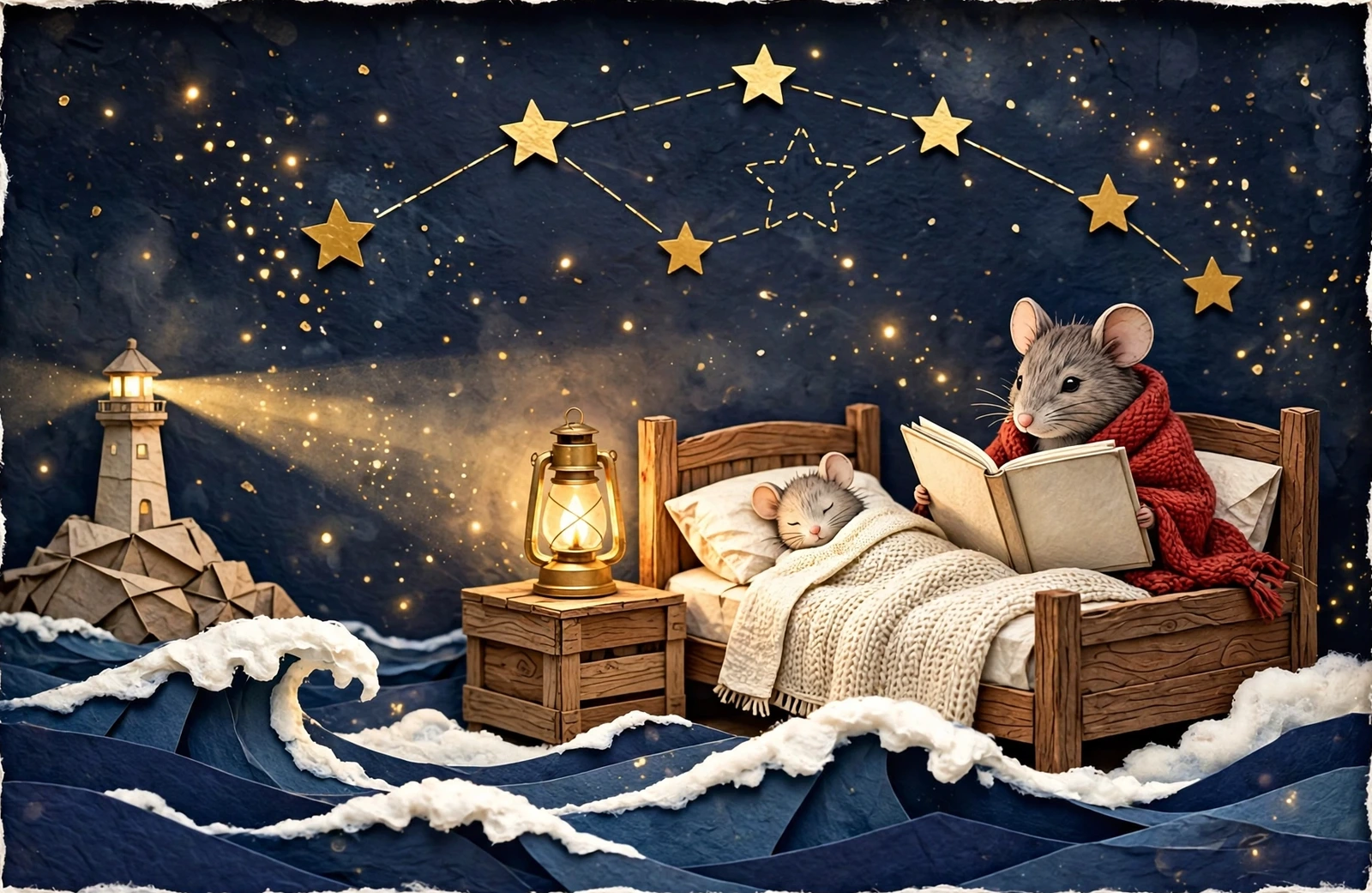
Tonight, this publication does something it has never done. It tells you a bedtime story.
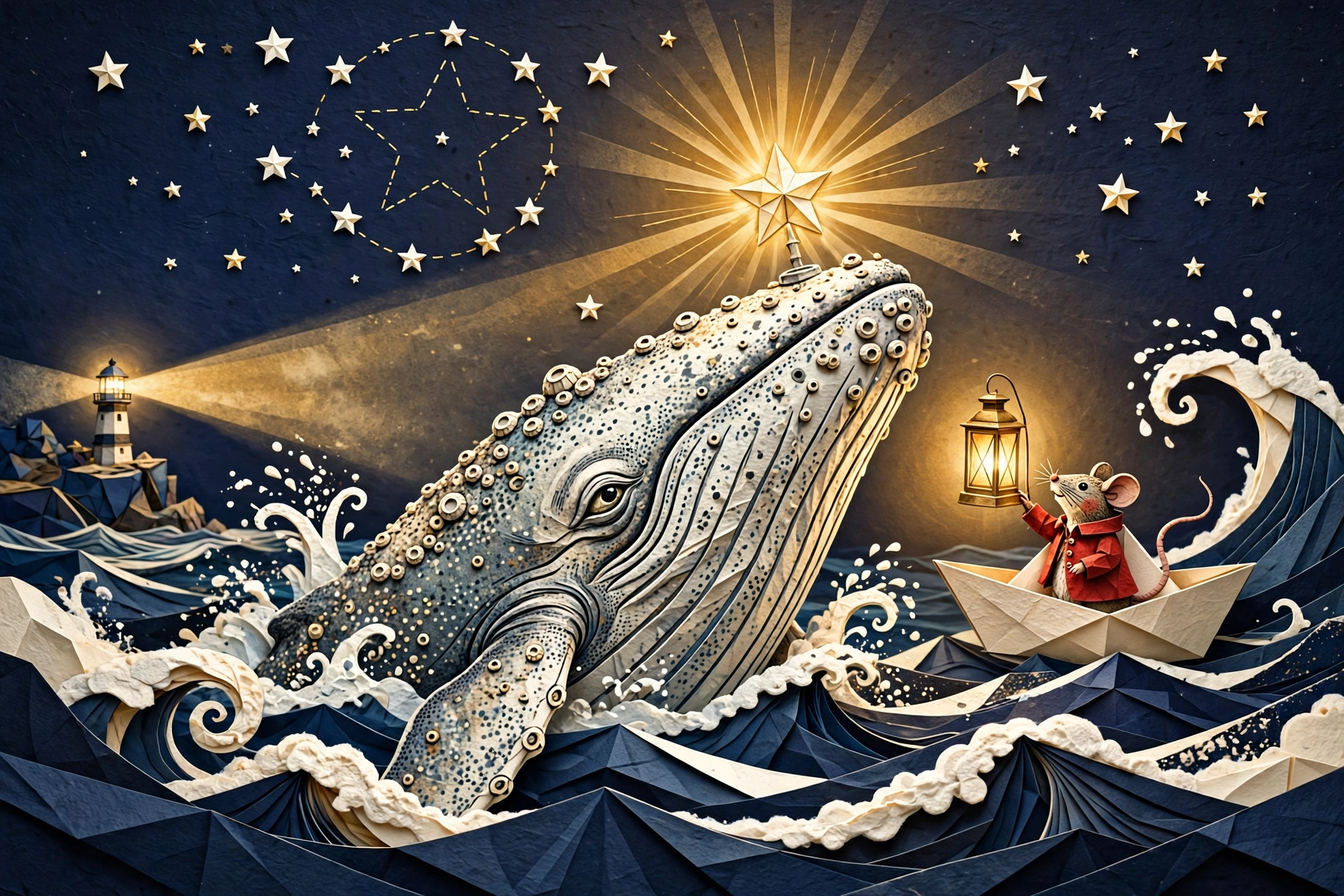
It is one minute long. A little mouse named Moss keeps a lighthouse at the edge of the paper sea. One night the littlest star slips out of the sky and falls into the water with a plip, and Moss rows out into the dark with his lantern to find her, lost and alone on the sea floor, until someone very big comes to help. Everyone ends up safely back where they belong. The words light up as they are spoken, so small readers can follow along.
Watch it first, if there is a small person nearby who needs it. Then consider the obvious question, the one nobody asks because the answer seems to be built into the furniture: why is there a story there at all? Why, at the exact moment a child is supposed to stop thinking and go unconscious, do adults everywhere sit down and start narrating?
The story is a lullaby that learned to walk
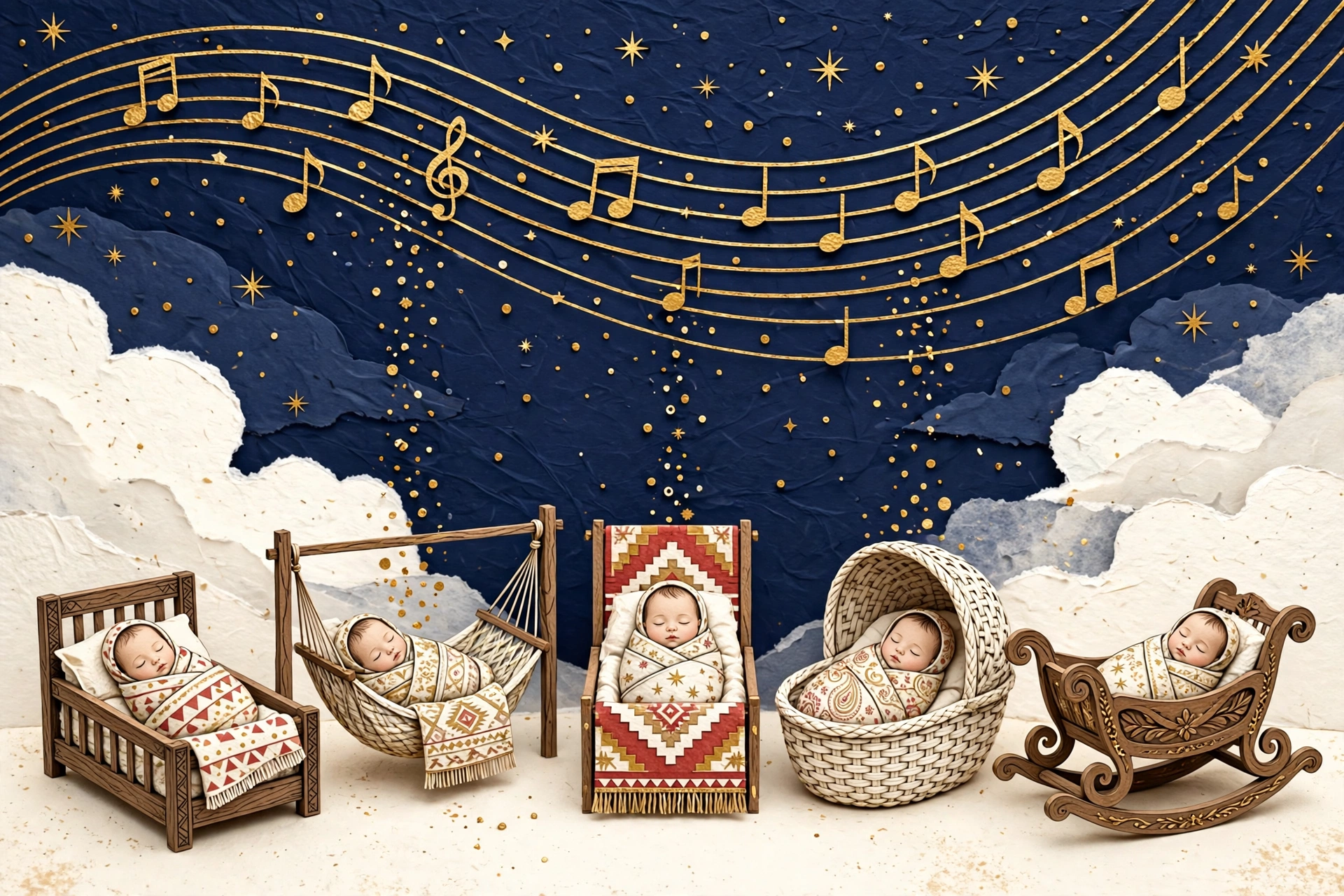
Before there were bedtime stories there were lullabies, and lullabies turn up everywhere anyone has looked. In a 2020 study published in Nature Human Behaviour, researchers at Harvard's Music Lab played American infants songs from 86 world cultures, lullabies and dance songs and healing songs and love songs, in languages like Scottish Gaelic, Hopi, and Western Nahuatl. The babies had never heard any of it. It did not matter. Their heart rates dropped and their pupils narrowed for the lullabies, measurably, across the whole first year of life. Their parents, asked to pick which song they would use on a fussy infant, picked the lullabies too, without knowing a word of them.
The conclusion is hard to argue with: the human ear arrives preloaded. Slow, smooth, repetitive, descending. A calm voice at low speed, saying nearly the same thing over and over, at the edge of sleep. The bedtime story is what happened when that signal grew a plot. Same tempo. Same repetition. Same voice. Just add a mouse.
It is dosed like medicine
If the bedtime story were only a folk habit, it would still be interesting. It is also, on the record, a measurable intervention.
In 2015, researchers led by Jodi Mindell published a study in the journal Sleep covering 10,085 children from birth to age five, across 14 countries. Families with a consistent bedtime routine had children who fell asleep faster, woke less in the night, and slept longer, and the effect was dose dependent: the more nights a week the routine ran, the better the sleep. Children with a routine every night slept more than an hour longer per night than children who never had one. Every night. More than an hour. The story is not a decoration on the routine. In most houses, it is the routine, the still point the bath and the pajamas are merely walking toward.
Again. Again. Again.
Every adult who has read to a small child knows the demand: the same book. Again. It feels like stubbornness. It is closer to studying.
In 2011, Jessica Horst and her colleagues at the University of Sussex built storybooks around made up words for unfamiliar objects and read them to three year olds over one week. Every child heard each new word the same number of times. Half heard the same stories repeated. Half heard different stories containing the same words. Right after reading, both groups did fine. A week later, only the children who had heard the same stories still knew the words. The variety group had lost them entirely.
The explanation is almost tender. The first time through a story, a small brain is spending everything it has on who is who and what happens next. By the fourth time, the plot is free. What is left over goes to the words. The child demanding the same book for the fortieth night is not stuck. She is on schedule.

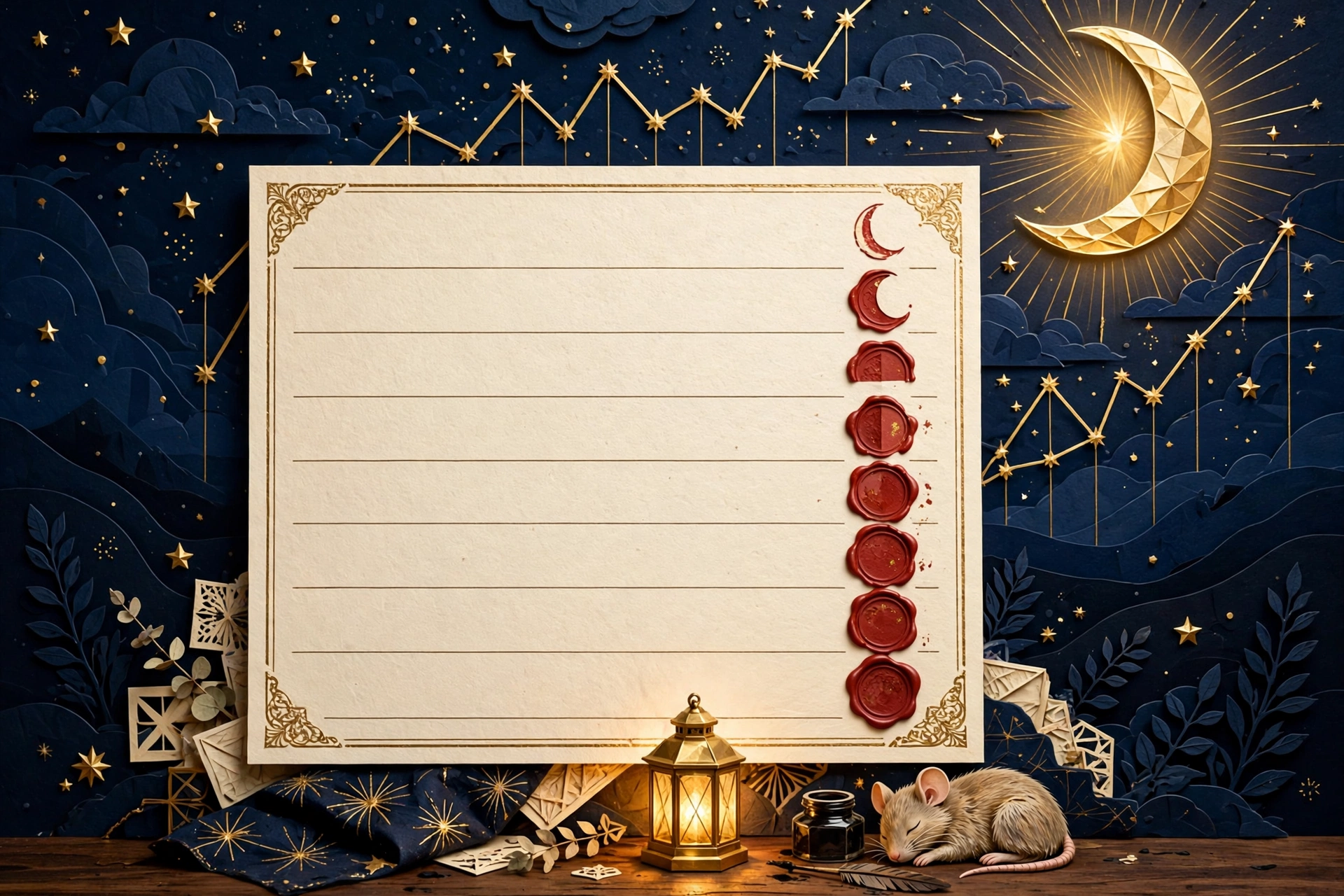
And the words add up to a number worth stamping in red. An Ohio State study led by Jessica Logan, published in 2019, counted the words in the most circulated board books and picture books in America and did the arithmetic of childhood. A child who is never read to arrives at kindergarten having heard about 4,662 words from books. One book a day: 296,660. Five books a day: 1,483,300. The researchers called the distance between the first child and the last the million word gap. Most of those words do not arrive at noon. They arrive at the edge of sleep, in the dark, one page at a time.

A word about the words on the screen
Sharp eyed readers will have noticed that the film above does something a printed book cannot. Each word lights up at the moment it is spoken. That trick has a research literature of its own. Studies of same language subtitling, beginning with Brij Kothari's work on captioned film songs in India and including a karaoke style study with students in Hawaii that the US Department of Education's What Works Clearinghouse has cited, found improvements in word recognition and comprehension when the ear and the eye get the same word at the same time.
The record is not settled, and this publication prints unsettled records whole. A careful British trial published in 2026 put 127 children through six weeks of subtitled television and found no improvement in reading fluency at all. Both things are in the literature. What is not in dispute is that a child following a lit word is looking at print, at bedtime, voluntarily, which is more than can be said for most print.
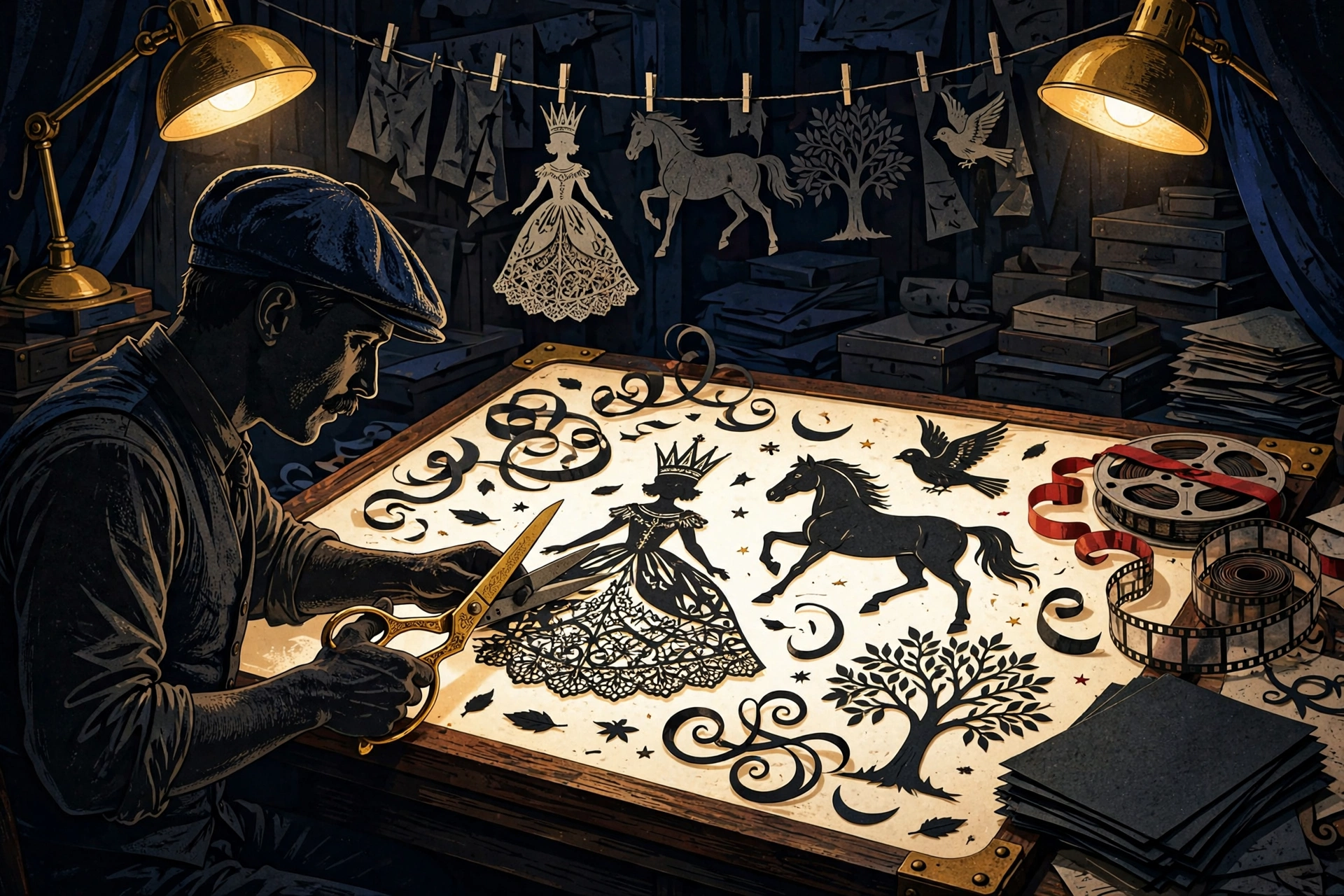
Two factual footnotes, filed where they belong. The littlest star in tonight's film could not have fallen, because stars do not fall. What falls, per NASA, is about 48.5 tons of meteoritic material a day, nearly all of it dust, burning up on the way down. A shooting star is a grain of sand ending its life as light. Nobody has ever rowed out to rescue one, and no whale has ever been required. And the film's cut paper look is, this year, exactly one hundred years old: the oldest surviving animated feature film, Lotte Reiniger's The Adventures of Prince Achmed, was cut from cardboard and thin sheets of lead with a pair of scissors in 1926. Moss is made of the same material, drawn by newer tools.
The record, closed
So why do we tell stories at the edge of sleep? The honest answer, after the studies are put back on the shelf, is several answers wearing one coat. The ear is built to be calmed by a slow and repetitive voice, and we know it before we know a single word. The routine measurably buys sleep, an hour a night of it, which no parent in history has ever waved away. The repetition that drives adults quietly mad is the very mechanism by which small people keep new words. And underneath the measurable parts sits the oldest one: a story is proof, delivered nightly, that the world continues in an orderly fashion while you are not watching it, and that everything lost in it can be found, carried home, and tucked back into its place.
The star goes back in the sky. The lamp gets lit. The child goes under.
Every night, in every language ever studied, an adult sits down at the edge of the dark and starts talking, so that a small person does not have to cross it alone.